Photo by Bokwe MAFUNA
Bokwe MAFUNA
VLUU L100, M100 / Samsung L100, M100
By Bokwe MAFUNA
When I received a phone call some few days ago from Molefe Pheto, I almost could not recognise his voice; as it was the first time I spoke to him over the phone; and I honestly did not expect to be called by him. So when he announced himself, I thought there was something serious that had occurred to him, or his family; or it was bad news about someone we both knew. That’s how we were brought up – sudden news could only be bad news. Like a telegram. Yet it was none of that. To my relief. But that relief was quickly replaced by anxiety, when he asked me to say something at the launching of his second book, ‘The Bull From Moruleng’.
I did not even remember the title of his first book, And Night Fell: Memoirs Of A Political Prisoner In South Africa as I had read it a long time ago in Paris, where it had remained when we moved back to South Africa in 1993. My wife, Nomakhaya, returned in 1994. She knew Molefe Pheto even longer than I, as she was born in Alexandra Township; and I only came there in 1959. So she helped me with some memories after I had committed myself. .How could I refuse such an honour?
I first met Molefe Pheto in Alexandra Township, when he was staying at Second Avenue, as a tenant at the home of Welile Nhlapo. That must have been around 1962, when I myself was a tenant at the Pilisos, who were our distant relatives, in Third Avenue. I was also used to Bra Gillie, Welile Nhlapo’s elder brother. And in that roundabout way got to know Bra Phin, as we all called him in Alex. He was a quiet person, and all I knew about him then was that he was a trumpet player; but strangely was not a member of one of the Jazz bands that were in Alexandra Township. Those were the days before Black Consciousness, and Bra Phin, was not yet known to be Molefe. And I remember I used to see him sometimes late at night, coming from, I presumed either Wits or Dorkay House, carrying his trumpet case. I was among a group of friends frequenting a cultural club at the Alex Clinic, and I think Bra Phin was a Board member at the clinic at the time. That was the Bra Phin I knew then…distant, reserved and cultured. I don’t think he drank alcohol, then and even now. A gentle somebody.
Ten years later, I was working at the Rand Daily Mail, as a journalist in the township section. We were covering news from the townships, and especially important those days were people playing a leading role in township life. I got wind of his going to, or was it coming back from London? I can’t quite remember. I believe it was one of the Serote brothers who told me; there was Wally and Gideon Serote, who were close friends of mine, and also of Bra Phin’s, and they were later to become involved with his cultural activities, in Mihloti, Mdali and other things. We are still in 1969, or thereabouts. So when I learnt Bra Phin’s London trip that was a nice little scoop for me, when he gave me an interview. I had never interviewed anybody at that level. I was justly proud of myself. In the black community it was rare for people to go to London to study music. Most of those who left with King Kong, did not return. And I hardly knew any of them, anyway; except Gideon Nxumalo, Hugh Masekela and Jonas Gwangwa, and Blyth Mbityane; but I could hardly claim I was close to them. I had also seen Mirriam Makeba in concert at the Odin Cinema, in Sophiatown in the early 50s.
But here was somebody who went to London, had sharpened his musical skills, and brought back his knowledge to transplant into a culturally starved community. This was when Bra Phin’s career of cultural activity took off and it became noticed even by the ever watchful and omnipresent Special Branch and the secret services of the apartheid government.
But not in Alexandra among his own people. He was just an anonymous musician busy somewhere with children and attending Wits. But this was not his fault, it was due to the fact that in the 60s and 70s the apartheid regime had reduced black people into zombies. They feared even to look at themselves in the mirror. And the word politics was anathema. Bra Phin certainly looked like the type of person who would be secretly involved in something. He was just so quiet. And he had been overseas. He didn’t drink. You never saw him at parties. He just looked like he might be involved in something. And indeed he was.
The ANC and PAC were existing in some dim memories of a time long gone. And it was in that space that the BCM and its political and cultural activistsneeded to plough seeds of revolt, of revolution, of awakening consciousness and self-esteem among a down trodden nation. Bra Phin played a crucial role in that silent war. The war for the soul of the oppressed minds of black people. Those were the days of Staffrider. The days when Mafika Gwala and Lefifi Tladi, and Dashiki commanded our attention. And Techon in Natal. And the universities were on fire; but not much was happening in the townships and rural areas.
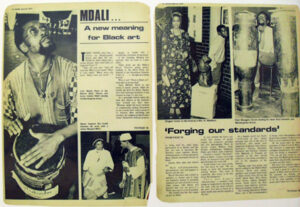
That’s when Molefe Pheto appeared on the scene with theatre of the revolution. With Mihloti, and later Mdali. Exciting stuff – and dangerous. African drums permeated the slumbering giant’s ears. And the giant started to growl at his condition, for he was chained. Mental chains. Economic chains. Legal chains. Illegitimate chains.
Yet the impact of Molefe’s work could not be, and is still not, sufficiently appreciated. The role of the arts in raising consciousness has always been underestimated, yet it has been raised to its true status elsewhere by people like Gabriel Garcia Marquez, who died on the 17th April, and whose support for the Cuban Revolution is legendary. Another writer, who understood and elevated the role of the cultural role in a revolution was Isabella Allende, from Chile, whose work is celebrated in all countries. One can also mention the late Kenule “Ken” Beeson Saro Wiwa the Nigerian writer, television producer, environmental activist, among African’s giants. There are many others, yet their names are not household names in Afrikan society.
Our present government too, simply underestimates the role of culture in developing a nation coming out of the bondage of mental slavery. Yet in the early 70s, our sons and daughters, brothers and sisters here understood it. Steve Biko, did. Mthuli ka Shezi did. Strini Moodley did. Mandla Langa did. Christine Qunta did. So did Nomsis Kraai and Debs Matshoba. And Sam Moodley. And Matlepa Mohapi. And Ben Langa. Some laid their lives for it. Some are still living in the shadows of yesterday’s battles. Many are forgotten and unknown. Nothing about them in our history books; in schools and in the media. Not even in shebeens. Yet that’s where people meet and dream.
The next thing we heard was that, like so many other people, Bra Phin was detained. It was in 1975, if I’m not mistaken. Just before the Soweto Uprisings. That was the time when my wife too was detained and held in solitary confinement for 14 months. Prior to 1975, there had been a groundswell of development in political consciousness among black communities brought about by cultural and political activists who were distinguishing themselves in everything they did, from the clothes they wore, hairstyles, the discussions they held, the events they attended.
Those were the days of Dashikis, and Afros. NO WIGS. And the names that people started using. Bra Phineas Pheto was now Molefe; Wally Serote resorted to Mongane; Milner Moroke enjoyed being Montshiwa. James Mafuna emerged as Bokwe. Barney Pityana reverted to Nyameko. However Moji Mokone remained Moji. So did Steve Biko, he continued being Steve. Yet was equally called Bantu. And Harry Nengwekhulu became as Rangwedzi. Everything was changing, in terms of cultural expression, literature, theatre, music, and thinking among the black communities. And playing a central role were the cultural workers, or fighters; or liberators. They were liberating the minds of the oppressed.
Ngugi wa Thiongo in his preface to Decolonising the Mind, said: ” Writers are surgeons of the heart and souls of a community”.
He was also describing the man whose work we are celebrating today. Molefe Pheto.
The same man who found himself hounded out of his country, into exile life in 1977, leaving his family behind following his gruelling detention by the security police, which experience he has shared with us in And Night Fell. His first book.
Some quotes from that book just for them who are not acquainted with Molefe’s work:
“To add insult to injury, that unbelievably shameless, most degenerate species of human degradation, the white warders, would actually stand at the entrances of the toilets and watch us squatting over the floor toilet-pails trying to shit the slimes out of our bodies. I could not believe that type of indignity, it was beyond me to comprehend their nonchalance at their own debasement.”
Yet another quote: “
As it rose higher, I realised its rays slanted southward, touching the entire south wall, signalling its move towards me. By midday, it began too dance away from me, its rays receding eastward on its journey westward, taking a course north of the cell. At about two in the afternoon I had given up hope. Its light was south-east, nowhere near where I was. Towards five o’clock, I saw the shadows made by my cell rising upwards on the east wall, by which time the sun was behind me, growing weaker, about to set. A lonely bird in the nearby park sang its farewell to day, to sun, to man and life and to me, as it went: Phez’ko mthwa’, Phez’ko mthwa’, Phez’ko mthwa’.
He continues:
“I remembered hearing this bird in Vendaland, in the northern Transvaal, during my music research projects, and I was to hear it too in Mozambique, and in Swaziland, where I went to rest after prison. Khosi Noge, my hostess, explained the lyrics of the bird-tune to me. Phez’ko mthwa’ meant ‘up and onto your burden’.
“I sank on the mat, spread out the three grey blankets, folded my black jersey to make an uncomfortable pillow and prepared myself to sleep at 5.30 in the afternoon…And, in a little while, night fell.
In 1977, a group of “cultural workers” from the townships fled into exile in Gaborone, Botswana; including Molefe Pheto, from Mehloti Theatre. Thami Mnyele followed in 1978. In Gaborone they established the cultural organisation Medu Art Ensemble (Medu is a SePedi word meaning roots), wrote Keorapetse Kgositsile, in his blog, Kagablog.
“Most of those who were associated with MEDU were active members of BCM inspired cultural groups such Milhloti and Mdali which performed at the rallies and meetings of Steve Biko’s South African Students Organisation (SASO) amongst others. But also undertook cultural work amongst the oppressed to raise consciousness”, wrote Andila Mngxithana in his piece on Thami Mnyele and MEDU Arts Ensemble Retrospective at Johannesburg Art Gallery.
From Botswana, Molefe left for London. During that period in London, I was out of touch with him, although I knew he was highly involved with the reorganising of the BCMA, and bringing together the various strands of South Africans through politics, culture, music and dance. And writing. The cultural weapons were being sharpened, and used to open the minds and hearts of compatriots, friends and supports of the Azanian struggle. He trained a number of youth in the art of drumming, and other instruments, picking up from what he had been doing back in South Africa at Orlando YMCA and other centres. What he had learnt in Mozambique, Swaziland and other parts of Afrika.
London, in those days served as the hub of South African exile activity – but not for everyone. It was also the dungeon of isolation for fighters from outside the ANC, the SACP and the anti-apartheid movement. To be outside the giant’s embrace meant isolation, it meant no scholarships for your children, it meant political wilderness. Sometimes it went as far as being labelled as spies; counter-revolutionaries; or sell outs. Especially after The second National Consultative Conference of the ANC was held at Kabwe, Zambia, from 16 – 22 June 1985. Yet the Molefes and others from the PAC, the Unity Movement, and the South African Youth Revolutionary Council ( SAYRCO) and BCMA cadres managed to survive. In 1982 at the London Conference of the BCMA where Molefe played a pivotal role a resolution taken Black Consciousness Groups to have Isandlwana Revolutionary Effort, the South African Youth Revolutionary Council, SAYCRO come under the umbrella of the Black Consciousness Movement of Azania, BCMA.The armed wing of the BCMA is Azanla, the Azanian National Liberation Army.
Isandlwana Revolutionary Effort whose cadres were mostly based in Botswana, later became part of Azanla. The history of Azanla is also in the shadows of our national heritage, and still needs to be uncovered and ownership taken by its proponents. Maybe today’s gathering might herald that change among us to take our place in the annals of this country’s history. But unless we do that ourselves, nobody else will feel compelled to. Comrade Molefe is one of the older veterans in Azanla and he can still serve as a source of inspiration and historical asset in the task ahead of making sure our role in the struggle for this country is properly documented. He has also been an inspiration in Azapo, since his return from exile and has served in several executive positions, selflessly and with dignity.
The one time I met him then, was in Paris, when he came to do research and work on a film he was involved in on how transnational companies were aiming to monopolize access to food supply by buying out and hoarding, and patenting seeds. Those were the early days of what is known today as GMOs. Genetically Modified Organisms in the food chain. Nobody then, and even today, paid much attention to such issues; not even the political parties nor the liberation movements at the time. Our government still has to wake up to that danger, where we find 95% of the staple food eaten by black people in South Africa is from GMO companies. Nobody even knew what Monsato was, and who controlled it. even today in this country you hardly ever hear any mention of it. And just to illustrate the point, hardly any parties garnering for our votes has anything to say about establishing sustainable food supplies to our people.
African Centre for Biosafety shared a link on this issue.
“Seeds have a fundamental place in the struggle for food sovereignty. With every growing cycle, the crops that feed the world’s peoples – how they are grown and by whom they are grown – depend on seeds. Seeds also transmit the vision, the knowledge, the practices and the culture of farming and peasant communities.
“For a hundred years, our seeds have been attacked by capitalist interests that have sought to privatize and standardize them to the benefit of industrial agriculture. In recent years, this dispossession process has been intensified, both through the new “Monsanto Laws”, which, by criminalising farmers for using their own farm-produced seeds, work to the benefit of industrially-produced registered or patented seeds, and through the genetic modification of seeds.
“However, in Africa, Asia, Europe, and the Americas, year by year there is growing strength in the organized peoples’ capacity for mobilisation and struggle against an agro-industrial system that gives rise to exploitation and death, grabbing land, poisoning food, and expelling peasants and indigenous peoples from their territories”.
Yet we are as landless as ever before in Azania. and the landless people ae also the poor of this country. The unemployed. The unskilled. The Uneducated.
This is where Molefe Pheto’s political awareness took him; he was already concerned with issues that were still dim to most of us, when what we were looking at was apartheid. This man realised deeper issues and things when most of us were dreaming like Rip van Winkel. But you hardly find much about him even in Google. Nothing in schools. Nothing on radio. That’s how he was trained; to be like a fish in the water; and not like a hippo in the mud. A true people’s freedom fighter, arming the minds of the oppressed with confidence and truth.
WhenNgugi waThiongo – in the Preface to Decolonising The Mind said: “Writers are surgeons of the heart and souls of a community”, he was talking about people like AuBut’MolefePheto. This is the Molefe Pheto I witnessed coming back from exile, setting the pace and going against the trend by settling himself with his family in heart of the Afrikaaner power base, the farmlands; buying a farm in Magaliesberg, to tame the shrew and naming it ‘Bangadile’. Setting the cat among the pigeons. Poetry to my ears.
Yet you would also see him frequently at functions of Azapo all the time, and quietly attending funerals of our beloved comrades; offering solace through the Afrikan Drums that have become his weapon of cultural expression and a healing tool for the wounded people of this country. We know they did nothing to heal those wounds that were inflicted upon millions of our people in the townships, in the rural areas, in the factories, in the prisons, in the schools, in the hospitals and clinics; and in every corner of the land by the apartheid capitalist regime. The TRC didn’t touch those wounds. And nothing has been done of substance to heal those wounds, caused mostly by the bloodless crime of three and a half centuries of economic exploitation. And psychological terror. Yet it caused countless victims.
Instead salt has been rubbed into those wounds; salt from the ruling party in the form of political arrogance, deceit, greed, aloofness from the people; and a general sense of impunity when the cadres of the ruling party waste and invade the nation’s resources. When jobs for pals also extend to sexual exploitation of our mothers, sisters and children. When rampant crime is allowed to spread to centres of learning and the sanctity of our homes. When rape of old grannies is as frequent as that of little toddlers; and that scourge has become as banal as the weather reports in the news. The challenge today facing the people of this country, the people calling themselves children of the soil, is at many levels. And it needs brave hearts and keen minds; and agile hands. And honesty. It needs writers, musicians, students, farmers, men and women steeped in the history and culture of their people. It needs patriots. It needs good schools and training centres to provide the tools of development for future generations.
When we were faced with the terror of apartheid and its vicious laws driven by the Herrenvolk philosophy, we were able to stand up against it and be counted. People like Molefe Pheto were there in the trenches. They gave up everything. They are still here today. And we are thankful that they are. Many did not make it, some are lying in unmarked graves, we don’t know where; and as we bear witness to the launching of yet another of his precious contributions, sharing his soul with his community by birthing ‘The Bull From Moruleng’, we say “well done Bra Phin”, and we salute your wife, Ous Dorcas and your children too, without whom you could not have made it; and I hope we will all soon be reading the new book, which we hope won’t be your last. Congratulations auButi Molefe, Khabo ejang Boreku; auButi waka, I am proud to have known you and to claim that:
Jy is ‘n tier en jy is een van ons.
Thank you all for your patience. And thanks for inviting my wife and myself. We are truly honoured.
Pula!
Bokwe Mafuna.
SOURCE